Free
Woad
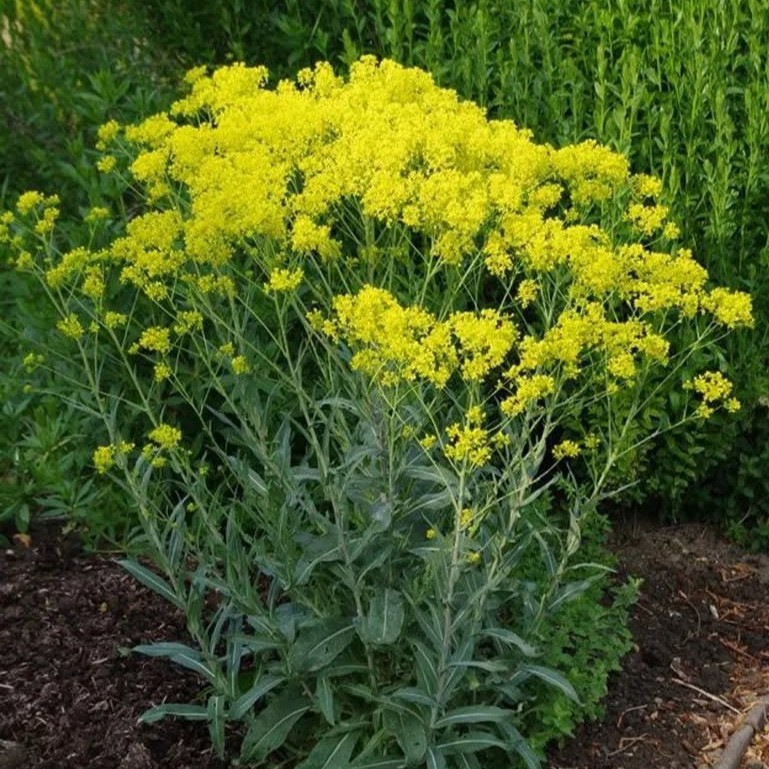
A historic European dye plant whose leaves produce a beautiful blue pigment. Woad is a hardy biennial, with leafy first-year rosettes followed by clouds of tiny yellow flowers in its second year.
10 in stock
Description
Best grown: Outdoors
Sowing time: Spring or autumn
Harvest time: First-year leaves once they are fully grown
Spacing: Around 30–45cm apart
Height: Up to 1.2m (4ft) when flowering
Position: Full sun
Difficulty: Easy to grow; extracting the dye is the interesting bit
Why grow it?
- The leaves contain the pigment used to make traditional woad blue
- An important part of Britain’s textile and dyeing history
- Forms a handsome blue-green rosette in its first year
- Produces airy clouds of small yellow flowers in its second year
- The flowers are attractive to bees and other pollinators
- A fascinating plant for natural dyers, textile growers and curious gardeners
How to grow: Sow thinly outdoors in spring where the plants are to grow, or sow in an outdoor seedbed in autumn and transplant the young plants in spring. Woad develops a taproot and is best moved while still small.
Choose a sunny position with well-drained soil. Woad particularly likes neutral or alkaline conditions, but it is a tough plant and will grow in most reasonably well-drained garden soils.
Woad is usually biennial. In its first year, it forms a low rosette of blue-green leaves. Harvest mature leaves during this first growing season if you want to use them for dye. Leave some plants unharvested and they should send up tall flowering stems the following spring, followed by masses of hanging seeds.
Woad can self-seed enthusiastically, so harvest the seeds before they scatter unless you want it to establish itself in the garden.
Dyeing / usage ideas: Woad leaves can be processed to produce a beautiful blue dye for natural fibres. The blue is created through an extraction and fermentation process rather than by simply boiling the leaves, so this is one for anyone who enjoys a proper plant-and-textile experiment.
These seeds were grown by nature and saved locally by Jane in July 2026.
Seeds per pack: 1 tablespoon